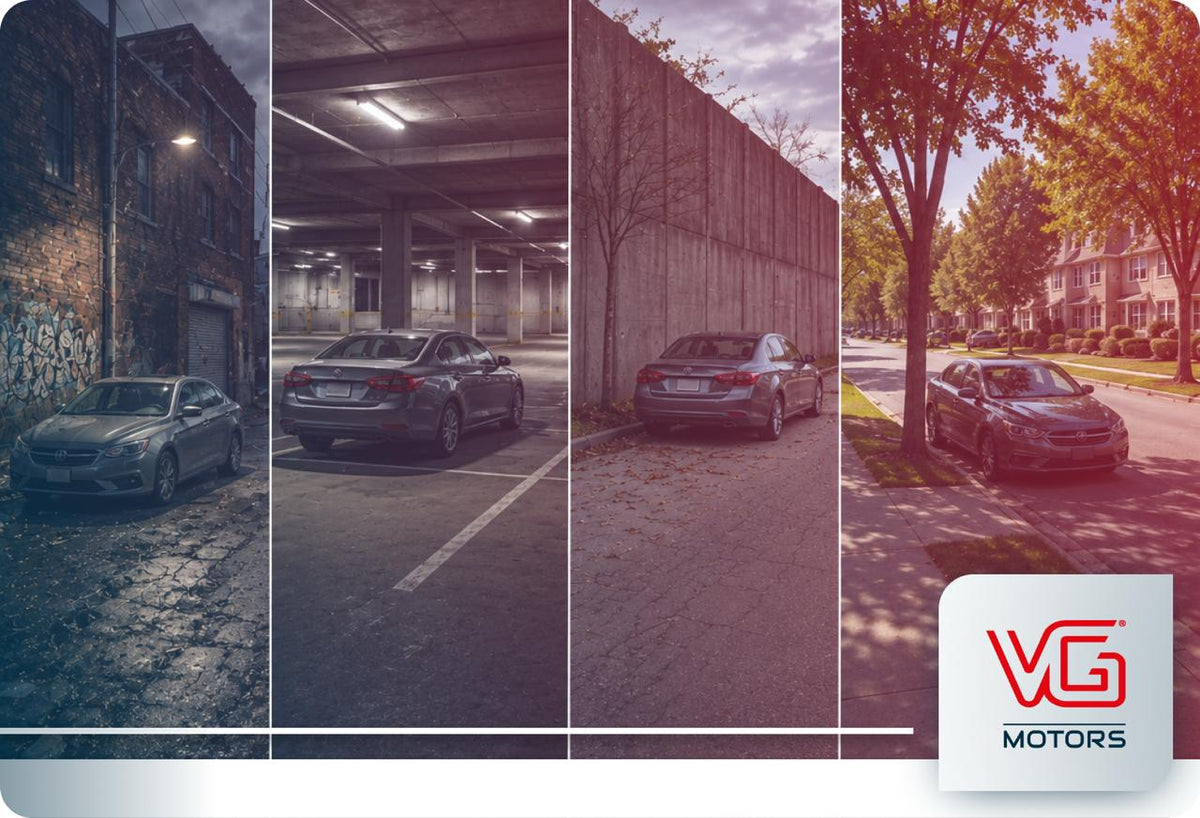
Yes. Where you park can influence vehicle theft risk because different environments create different levels of access, exposure and opportunity. A driveway, street, apartment garage or airport lot can place the same vehicle in very different conditions.
No parking location guarantees safety, but the environment around a vehicle can affect its exposure to theft.
You park your car in your driveway every night.
Another driver with the same model parks on the street.
Someone else leaves theirs in an apartment garage.
A fourth vehicle spends four days in an airport parking lot.
The cars could be identical. The environments around them are not.
That’s why asking whether one type of parking is “safe” or “dangerous” usually oversimplifies the issue.
A brightly lit garage isn’t automatically safe.
Street parking isn’t automatically dangerous.
A residential driveway doesn’t eliminate theft risk simply because the vehicle is close to home.
The more useful question is:
What conditions does this parking environment create around my vehicle?
That’s where parking begins to matter.
Parking Changes Exposure, Not the Vehicle
In our guide Why Some Vehicles Are Stolen More Than Others, we explained that vehicle theft risk can involve demand, vulnerabilities, exposure, opportunity and offender objectives.
Parking primarily changes the exposure part of that equation.
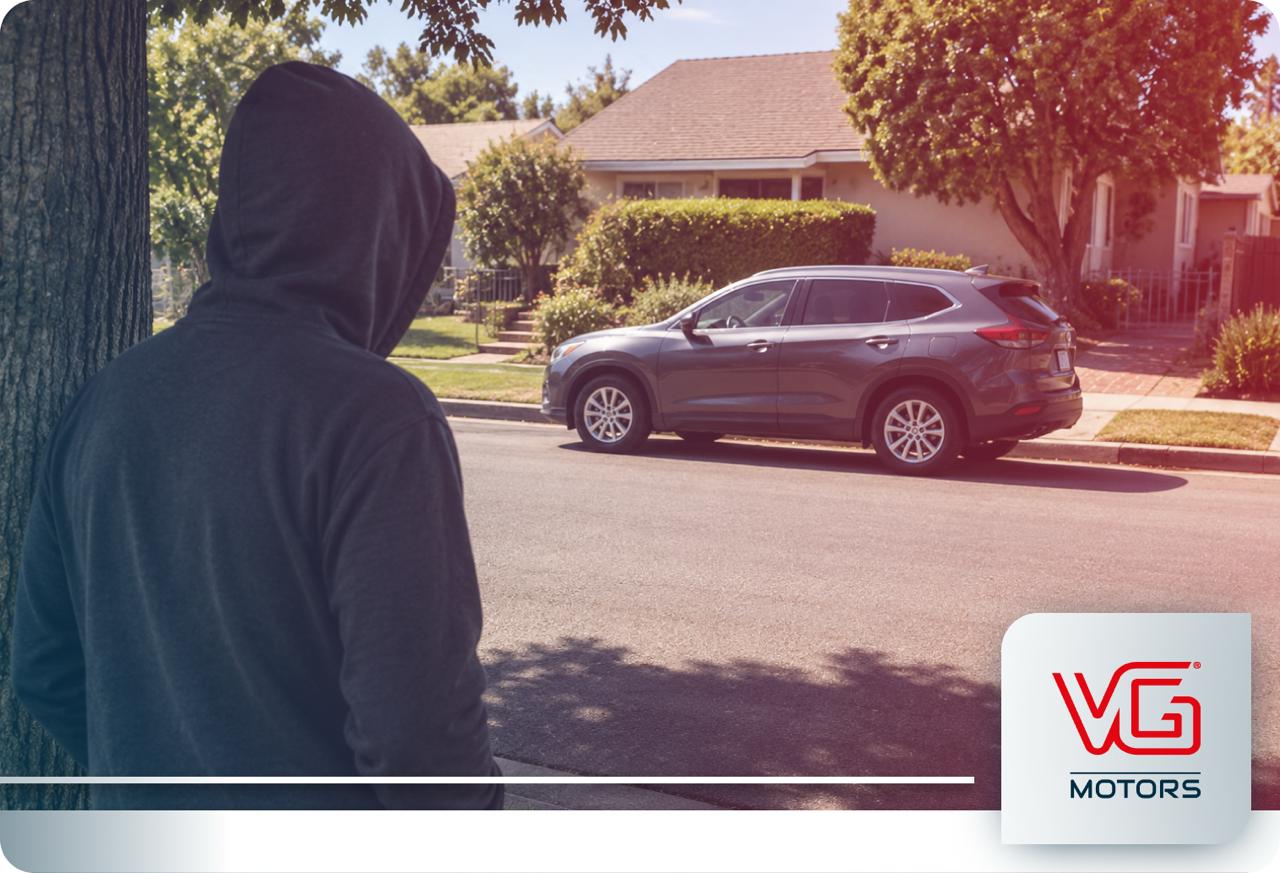
Consider the same SUV parked overnight in two places.
In Phoenix, Arizona, it might spend the night in a residential driveway.
During a trip to Los Angeles, California, the same SUV might spend the night on a public street.
Nothing about the vehicle itself has changed.
But its surroundings, accessibility, time unattended and activity around it may be different.
That distinction is fundamental:
Parking doesn’t change what the vehicle is. It changes the environment in which the vehicle is exposed.
What Actually Matters About a Parking Environment?
Drivers often evaluate parking intuitively.
“This looks safe.”
“This street looks sketchy.”
“There’s a light above my car.”
But appearance alone doesn’t tell the whole story. Several conditions can influence the exposure created by a parking location.
Access
Who can physically reach the vehicle?
A private residential garage creates different access conditions from a public street or an open commercial lot.
Time
How long will the vehicle remain there?
Twenty minutes outside a restaurant is different from several days at an airport.
Visibility
Can activity around the vehicle be observed?
NHTSA recommends parking in well-lit areas when possible as part of its vehicle-theft prevention guidance. NHTSA vehicle theft prevention guidance
But lighting is only one part of the environment.
Activity
A parking location can experience different patterns of vehicle and pedestrian traffic depending on the hour and use of the property.
Predictability
A vehicle that appears in the same place on a consistent schedule creates a different pattern from one making a short, irregular stop.
None of these factors predicts whether a theft will occur.
Together, however, they explain why parking location changes exposure rather than simply dividing places into “safe” and “unsafe.”
Is a Residential Driveway Safe?
Parking close to home can feel inherently secure.
Sometimes it offers meaningful advantages. The vehicle may be near the owner, residential cameras may be present and access may be more limited than in a large public parking facility.
But a driveway is still an accessible environment.
A vehicle parked outside a home in Phoenix or Dallas may remain in approximately the same place for many hours each night.
That creates a predictable pattern.
NICB has also warned that opportunistic offenders may move through residential areas and parking lots checking vehicles for unlocked doors. NICB vehicle theft prevention resources
The useful conclusion isn’t: Driveways are dangerous.
It’s:
Being at home doesn’t automatically remove the conditions that can create theft opportunity.
Locking the vehicle, removing the keys and avoiding leaving valuables visible still matter when the car is parked twenty feet from your front door.

What About Street Parking?
Street parking changes the environment again.
A vehicle may be accessible to anyone passing through the area, but it may also sit in a highly visible location surrounded by pedestrians, residents, businesses or traffic.
That’s why saying street parking = high theft risk is too simplistic.
Consider street parking in Los Angeles.
One vehicle might be on an active block with businesses and constant movement.
Another might be on a quiet street with very little overnight activity.
Both are technically “street parked.”
Their environments are quite different.
This is an important principle throughout this article: The category of parking matters less than the actual conditions within it.
Are Apartment Parking Garages Safer?
Apartment garages can create a false sense of certainty in either direction.
Some people assume: “It’s inside a garage, so it’s protected.”
Others hear about garage theft and conclude: “Parking garages aren’t secure.”
Neither conclusion is particularly useful.
An apartment garage in Miami, Florida, for example, could have controlled entry, cameras and significant resident activity.
Another could have open access or different physical conditions.
Even within the same property, parking near an entrance can create a different environment from parking in a less active section.
The word garage doesn’t tell you enough.
What matters is how that particular garage manages access and what conditions exist around the vehicle.

Airport Parking Creates a Different Kind of Exposure
Airport parking introduces another variable: Time.
Suppose you park at Dallas Fort Worth International Airport before a four-day trip.
The important difference isn’t simply that the vehicle is at an airport.
It’s that the vehicle may remain unattended for several days.
Compare that with stopping at a grocery store for twenty minutes.
The vehicle hasn’t become inherently easier to steal because you bought a plane ticket.
The duration and circumstances of exposure changed.
Airport facilities also vary considerably. Parking structures, remote lots, valet services and off-airport facilities can have different access controls and operating environments.
So once again, the useful question isn’t: “Is airport parking safe?”
It’s: “What are the conditions of the facility where I’m leaving my vehicle, especially for an extended period?”
Shopping Centers and Workplace Lots Are Different Again
A shopping-center parking lot may have substantial activity during business hours and far less activity after closing.
A workplace parking lot may be busy when employees arrive, relatively stable for hours and active again at the end of the workday.
A hotel lot may contain vehicles belonging to people who are unfamiliar with the area and staying overnight.
The point isn’t to rank these locations.
It’s to recognize that parking environments change over time.
The same parking space can exist under very different conditions at noon and at 2:00 a.m.
That makes another distinction important: Where you park matters. When you park there can matter too.
Well-Lit Does Not Mean Theft-Proof
“Park somewhere well-lit” is good general advice.
NHTSA recommends it.
But it shouldn’t be misunderstood as a guarantee.
Lighting can increase visibility and is one feature owners can consider when choosing where to leave a vehicle. NHTSA vehicle theft prevention guidance
It does not control:
- who can access the area;
- how long the vehicle remains there;
- whether the vehicle is locked;
- whether keys are inside;
- whether someone has deliberately targeted that vehicle.
So: Better lighting can improve the parking environment. It doesn’t make the other variables disappear.
This is why vehicle-theft prevention works better as layered risk reduction than as a search for one “safe” parking characteristic.
Does Parking Near Cameras Prevent Vehicle Theft?
Cameras can be useful security infrastructure.
But the presence of a camera should not be interpreted as proof that theft cannot happen.
Systems differ in coverage, image quality, monitoring, retention and how footage is accessed after an incident.
A sign saying 24-hour surveillance also doesn’t tell a driver everything about how that system operates.
From the owner’s perspective, cameras are better understood as one feature of the environment, not a guarantee attached to a parking space.
The same principle applies to gates, guards, lighting and controlled entry.
Each may change the conditions around the vehicle.
None should be treated as an absolute.
Parking Environment and Target Attractiveness Are Related, but Different
There’s an important boundary here. Parking determines the environment surrounding the vehicle.
The vehicle itself may then present cues that affect whether it attracts someone’s attention.
For example, an accessible parking lot creates one set of conditions.
A laptop sitting visibly inside one of the cars creates another.
We explored that second decision separately in: What Makes a Vehicle an Attractive Target for Thieves?
The distinction is useful:
Parking asks: What environment surrounds the vehicle?
Target selection asks: Why this vehicle within that environment?
Both can matter without being the same thing.
So Where Should You Park?
There isn’t one type of parking that can be declared universally safest.
Instead, when you have a meaningful choice between parking locations, look at the actual environment.
Consider:
- whether access appears controlled;
- whether the area is reasonably visible and illuminated;
- how long the vehicle will remain unattended;
- what activity exists around the location;
- whether available security features are actually relevant to the facility.
- Then take care of the factors you control inside the vehicle.
NHTSA recommends removing keys, closing and locking doors and windows, keeping valuables out of sight and parking in well-lit areas when possible. NHTSA vehicle theft prevention guidance
You don’t need to find a mythical theft-proof parking space.
You need to avoid assuming that the name of the parking environment tells you everything about the risk.

Bottom Line
Where you park can matter. But not because every driveway is safe, every street is dangerous or every garage is secure.
Parking matters because it changes the conditions around the vehicle.
Access.
Time unattended.
Visibility.
Activity.
Predictability.
The same car can spend tonight in a residential driveway, tomorrow afternoon in a shopping-center lot and next week several days at an airport.
The vehicle hasn’t changed.
Its exposure has.
That’s the useful way to think about parking and vehicle theft risk.
FAQ - Does Where You Park Matter for Vehicle Theft Risk?
Does where you park affect the risk of car theft?
Yes. Different parking environments can create different levels of access, exposure, visibility and time unattended. No specific type of parking guarantees that a vehicle will or will not be stolen.
Is driveway parking safe from car theft?
A driveway may provide different conditions from public parking, but it doesn’t eliminate theft risk. Vehicles should still be locked, keys removed and valuables kept out of sight.
Is street parking more dangerous than garage parking?
Not necessarily in every situation. Street and garage environments vary significantly. Access, activity, visibility, security features and other conditions can be more informative than the parking category alone.
Are apartment parking garages safe from vehicle theft?
Controlled entry, cameras and other security measures may improve the environment, but a garage cannot guarantee that theft will not occur. Security conditions vary between properties.
Is airport parking more likely to result in car theft?
An airport parking facility should not automatically be considered high-risk simply because it is at an airport. One meaningful difference is that vehicles may remain unattended for extended periods, and security conditions vary among facilities.
Does parking in a well-lit area prevent car theft?
No. NHTSA recommends parking in well-lit areas when possible, but lighting is one risk-reduction measure rather than a guarantee against theft.
Do parking lot cameras prevent vehicle theft?
Cameras may contribute to security and may provide useful information after an incident, but their effectiveness depends on factors such as coverage, monitoring and image quality. Their presence does not make a parking location theft-proof.



Leave a comment
This site is protected by hCaptcha and the hCaptcha Privacy Policy and Terms of Service apply.