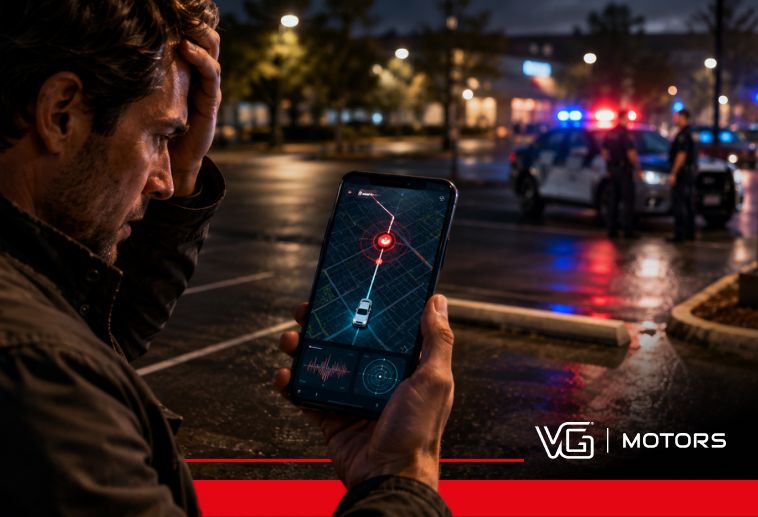
This is usually the moment drivers stop caring about technology buzzwords. Because once a vehicle disappears, the questions become much more immediate:
- What happens now?
- Can the car still be tracked?
- Does the system work outside my city?
- How fast can the vehicle be recovered?
- Does the police actually use the tracking information?
And honestly, those are the right questions.
Modern vehicle theft moves extremely fast.
According to discussions referenced by the National Insurance Crime Bureau (NICB), organized theft groups increasingly prioritize:
- rapid movement;
- electronic theft methods;
- quick relocation;
- dismantling operations.
Which means the first hours after a theft matter enormously.
That’s exactly why current-generation recovery platforms evolved far beyond the original radio-only systems many drivers still remember.
Quick Answer: What Happens After a Vehicle Is Stolen?
Once a theft is discovered, the owner typically:
- confirms the vehicle is missing;
- contacts law enforcement;
- activates the recovery process through the app or platform;
- shares tracking information during the recovery workflow.
Modern LoJack systems combine encrypted GPS technology with connected monitoring and app-based theft-response workflows designed specifically for post-theft situations.
The goal is not simply:
“show the vehicle on a map.”
The goal is reducing the gap between theft discovery and active recovery response.

What Happens During the Recovery Process?
For many drivers, this becomes a stressful sequence happening within minutes:
confirming the theft, calling police, opening the app, trying to understand where the vehicle is moving, and figuring out what happens next.
In many real theft situations, drivers are dealing with:
- panic;
- police reports;
- insurance calls;
- rapidly changing information;
- transportation problems;
- uncertainty.
And that emotional chaos is exactly why response timing matters so much.
The typical recovery workflow often looks something like this:

How Does LoJack Detect a Vehicle Theft?
Modern systems typically do not automatically “know” a theft happened in every situation.
In most cases, the recovery process begins when:
- the owner notices the vehicle is missing;
- confirms it was stolen;
- activates the theft-response process.
This is one of the biggest differences between:
- passive tracking;
- and connected theft-response systems.
Modern platforms increasingly combine encrypted GPS technology with app-connected monitoring and recovery-oriented workflows designed specifically for theft situations.
Because after a theft occurs, reducing delays becomes extremely important.
What Does the Driver Need to Do?
The first step is usually confirming the vehicle was actually stolen and not:
- relocated;
- towed;
- borrowed;
- or parked elsewhere.
After that, the owner typically:
- contacts law enforcement;
- files a theft report;
- activates the recovery process;
- accesses tracking information through the app.
But in reality, this rarely feels calm or organized.
Most drivers are suddenly trying to:
- process the shock;
- communicate with police;
- notify insurance;
- follow vehicle movement;
- and understand whether recovery is still possible.
And meanwhile, the vehicle itself may already be moving rapidly.
That’s why modern recovery workflows increasingly focus on minimizing response delays after theft occurs.
Does the Police Participate in Vehicle Recovery?
Yes. Law enforcement participation still plays a major role in most recovery situations.
Modern systems increasingly allow drivers to:
- share real-time tracking information;
- provide location updates;
- help authorities follow vehicle movement more efficiently.
This is one reason current-generation systems feel very different from the original LoJack many drivers remember.
The classic version became famous partly because police departments used dedicated RF receiver infrastructure during recovery operations.
Today, the workflows are much more connected and app-oriented.
But law enforcement involvement still remains extremely important during recovery.
Does LoJack Work in Another City or State?
Yes.
Modern GPS-connected systems are no longer limited in the same way older radio-based infrastructure sometimes was.
Current-generation platforms typically provide broader coverage through:
- GPS connectivity;
- cellular communication;
- connected monitoring.
That allows tracking visibility and recovery coordination to continue even when vehicles move across:
- cities;
- counties;
- state lines.
And that matters because organized theft groups often relocate stolen vehicles extremely quickly after theft occurs.
Does LoJack Work Without Internet?
This is one area many drivers misunderstand.
Modern recovery systems usually rely on combinations of:
- GPS positioning;
- cellular communication;
- connected app visibility.
GPS satellites themselves do not require traditional internet access in the same way web browsing does.
But connected tracking visibility still depends heavily on communication networks.
That means some environments may temporarily affect tracking visibility, including:
- underground garages;
- parking structures;
- shipping containers;
- remote signal-limited areas;
- heavily shielded environments.
- Signal interruptions do not necessarily mean the system completely stops working.
But communication conditions can absolutely affect:
- update frequency;
- visibility timing;
- tracking responsiveness.
- And honest expectations matter here.
How Long Does Vehicle Recovery Usually Take?
Recovery timing depends heavily on:
- how quickly the theft is discovered;
- how fast the recovery process begins;
- vehicle movement patterns;
- theft circumstances;
- communication conditions.
Modern LoJack systems commonly reference an average recovery times around 26 minutes.
But recovery situations vary enormously.
Some vehicles may be located quickly. Others become harder to recover if they are:
- hidden temporarily in cooling lots;
- dismantled rapidly;
- relocated repeatedly;
- moved into shipping operations.
- This is why response timing matters so much.
Because organized theft operations increasingly prioritize speed after theft occurs.
Can LoJack Recover Every Stolen Vehicle?
No recovery system can guarantee recovery in every situation.
Vehicle retrieval outcomes depend on factors such as:
- response timing;
- theft sophistication;
- communication conditions;
- signal availability;
- vehicle movement speed.
Some organized theft operations are extremely sophisticated.
That’s why connected recovery platforms increasingly focus on:
- reducing response delays;
- improving visibility;
- accelerating theft-response workflows;
- improving recovery probability.
- The goal is improving outcomes.
Not promising impossible guarantees.
LoJack vs AirTag vs Basic GPS Tracker

Why Modern Vehicle Theft Changed Recovery Technology
Years ago, many stolen vehicles were:
- abandoned nearby;
- temporarily joyridden;
- recovered relatively quickly.
Modern theft looks very different.
According to discussions referenced by the NICB and broader insurance industry reporting, organized theft groups increasingly use:
- rapid relocation;
- cooling lots;
- dismantling operations;
- export pipelines;
- VIN switching.
Which means delays become expensive very quickly.
That’s exactly why connected recovery technology evolved toward:
- app-based visibility;
- GPS-connected tracking;
- faster response workflows;
- coordinated theft-response systems.
Because modern theft increasingly operates like organized logistics.
Not random opportunistic crime.
Should Drivers Rely Only on LoJack?
The best vehicle protection strategies are usually layered.
That may include:
- safe parking habits;
- steering wheel locks;
- garage storage;
- factory anti-theft systems;
- connected recovery platforms.
Because no single system completely eliminates theft risk.
Modern vehicle protection works best when:
- prevention;
- awareness;
- and post-theft response
All work together.

So… How Does LoJack Actually Help After a Theft?
The biggest difference is this:
Current-generation systems are designed to reduce the time between:
theft discovery, and active response.
Because after theft happens, drivers rarely care about:
- tracking terminology;
- hardware language;
- technical buzzwords.
They care about one thing:
Reducing the time between panic and recovery.
How Does LoJack Work When a Car Is Stolen? — FAQ
What happens after a car with LoJack is stolen?
The owner typically confirms the theft, contacts law enforcement, activates the recovery workflow, and shares tracking information during the recovery process.
Does LoJack automatically detect theft?
Not always. In many situations, the owner activates the theft-response process after discovering the vehicle is missing.
Does LoJack work across state lines?
Yes. Modern GPS-connected systems generally provide broader geographic coverage than older RF-only infrastructure.
Does the police participate in recovery?
Yes. Law enforcement still plays an important role in most stolen vehicle recovery situations.
Does LoJack work underground or inside parking garages?
Signal conditions inside underground garages, parking structures, and shielded environments may temporarily affect connected tracking visibility.
How long does vehicle recovery take?
Recovery timing varies depending on the theft situation, response timing, and vehicle movement patterns.
Can LoJack recover every stolen vehicle?
No. No recovery platform can guarantee recovery in every scenario, especially in highly sophisticated theft situations.
Is LoJack better than an AirTag?
AirTags were designed primarily for locating personal items, while LoJack systems are designed specifically around vehicle theft-response workflows.



Leave a comment
This site is protected by hCaptcha and the hCaptcha Privacy Policy and Terms of Service apply.