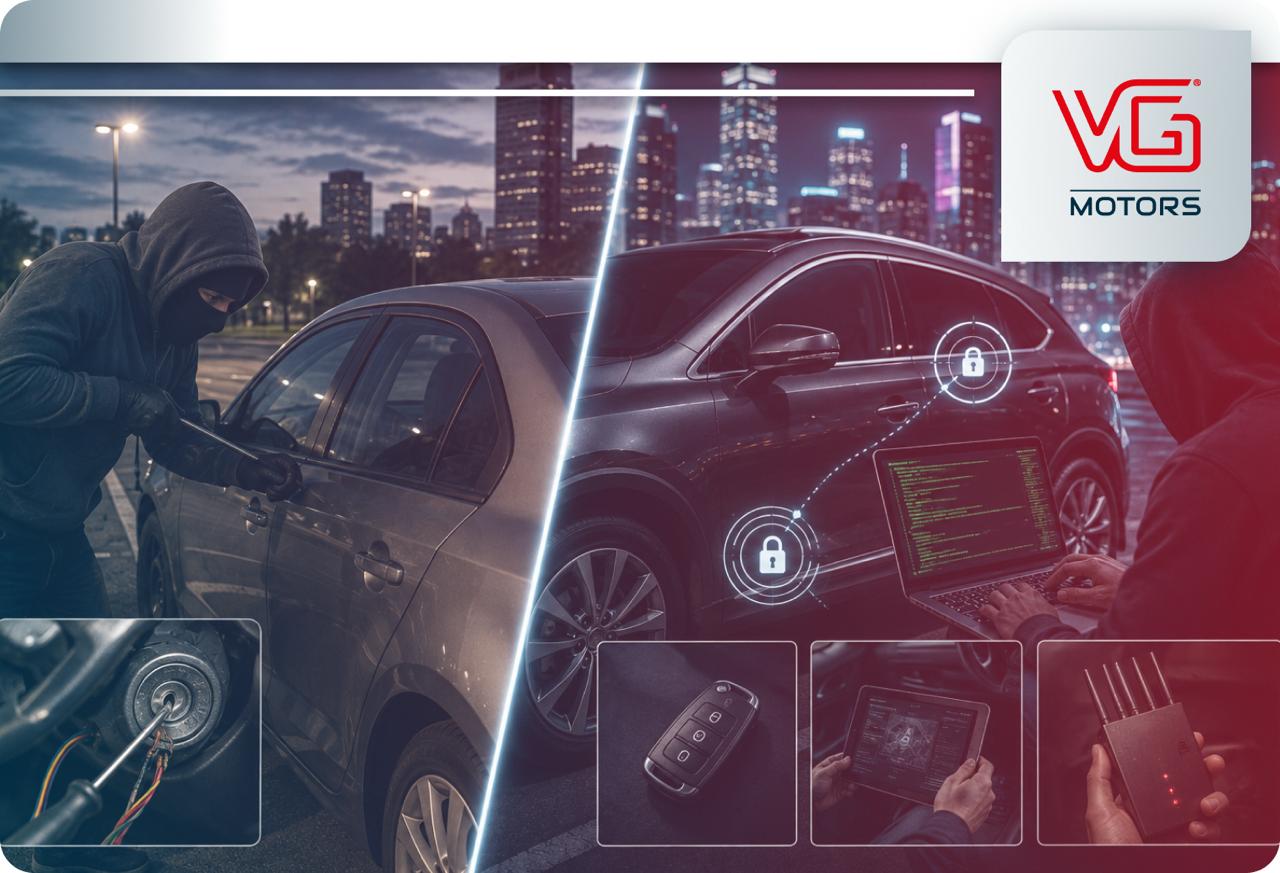
Vehicle theft has changed over the past decade as vehicles became more electronic, information about vulnerabilities began spreading faster, and manufacturers gained new ways to respond. Yet many basic theft opportunities remain familiar.
The biggest change may be how quickly the entire theft environment can now evolve.
Think about the technology surrounding an everyday car in 2016.
Now think about a new vehicle today.
Electronic authentication, key fobs, immobilizers, connected features and software play a larger role in how many vehicles operate and protect themselves.
But the vehicle isn’t the only thing that changed.
Information moves faster.
A vulnerability discovered in one place can become widely known.
Manufacturers may respond through software as well as hardware.
Drivers can learn about emerging theft problems almost immediately.
And yet, after all that technological change, authorities still remind drivers to take their keys, lock their doors and avoid leaving vehicles running unattended.
So is vehicle theft today actually different from vehicle theft a decade ago?
Yes, but not because the old problem disappeared.
Vehicle theft evolved because vehicles, information and prevention evolved around it, while many basic opportunities remained.
The Numbers Show a Decade of Change
The last decade didn’t follow a simple upward or downward trend.
In 2016, the FBI estimated 765,484 motor vehicle thefts in the United States.
Then theft climbed dramatically.
NICB reported:
2016 — 765,484
↓
2023 — 1,020,729
↓
2024 — 850,708
↓
2025 — 659,880
As of August 2026, 2025 is the latest complete national year available, so it provides a more appropriate endpoint for national comparisons than incomplete 2026 data.
And that timeline reveals something important.
Vehicle theft exceeded one million in 2023 before falling 17% in 2024 and another 23.2% in 2025.
In fact, fewer vehicles were reported stolen nationally in 2025 than the FBI estimated in 2016.
That doesn’t mean theft became steadily less important over the decade.
Quite the opposite.
The last decade shows that vehicle theft can change significantly—and quickly.
Technology is part of that story, but so are specific vulnerability waves, offender behavior, manufacturer responses, law enforcement, prevention and public awareness.

Vehicle Security Became More Electronic
One clear difference between the beginning and end of this period is the growing role of electronics in vehicle security.
Modern vehicles increasingly rely on features such as electronic authentication, coded credentials, immobilizers and software-controlled systems.
These technologies can create meaningful barriers that weren’t present in the same way across older vehicles.
But that’s the historical point we need here.
Not how every system works.
Not whether one technology is “best.”
Simply: As vehicles became more electronic, vehicle security became more electronic too.
That changed the types of barriers surrounding modern vehicles—and changed some of the problems manufacturers and owners have to think about.
Information About Vulnerabilities Can Spread Much Faster
Perhaps the most important change of the decade happened outside the vehicle.
Information became faster.
Social media can take knowledge that once might have remained limited to a small group or geographic area and expose it to an enormous audience.
The Hyundai/Kia theft wave provides a documented example.
NHTSA described how a social-media challenge contributed to thefts involving certain vehicles. Hyundai and Kia subsequently announced theft-deterrent software covering approximately 3.8 million Hyundai and 4.5 million Kia vehicles that lacked an immobilizer.
The important lesson here isn’t how those vehicles were stolen.
It’s what happened to the information.
A vulnerability in one vehicle is a technical problem. A vulnerability that becomes widely understood can become a behavioral trend.
That creates a very different environment from one in which knowledge travels slowly.
And the acceleration can work in the other direction too.
Manufacturers can communicate with owners, deploy software changes where applicable, introduce hardware measures and publicize responses.
Owners can learn that their particular vehicle may require attention.
The same information environment that can amplify a problem can also help accelerate a response.
That’s an important evolution in vehicle theft: The feedback loop became faster.
Vulnerability.
Awareness.
Behavior.
Manufacturer response.
Owner response.
Not every theft trend follows that sequence, and not every vehicle problem can be solved through software.
But the speed at which information can influence theft risk is now part of the security environment itself.

Some Basic Theft Opportunities Never Disappeared
This is where the story becomes more interesting.
After a decade of increasingly electronic vehicles, software updates and connected technology, some of today’s prevention advice would sound completely familiar to a driver in 2016.
NHTSA and NICB still recommend basic precautions such as:
- take your keys or fob;
- lock the vehicle;
- close the windows;
- avoid leaving the vehicle running unattended;
- keep valuables out of sight;
- consider the environment where you park.
Why?
Because technological evolution doesn’t eliminate human behavior.
A sophisticated vehicle can still be left unlocked.
An advanced key fob can still be left behind.
A modern vehicle can still be left running unattended.
And an everyday parking situation can still create an unnecessary opportunity.
This prevents us from making the opposite mistake when studying vehicle-theft trends: New technology doesn’t mean every theft has become technologically sophisticated.
Some risks changed because vehicles changed.
Others remain because basic opportunities still exist.
What This Decade Actually Teaches Drivers
Looking at ten years of vehicle theft shouldn’t leave drivers trying to memorize whatever theft method happens to be making headlines.
The more useful lesson is that risk isn’t static.
A vehicle that seemed unremarkable from a theft perspective can become part of a broader trend.
A vulnerability can become widely known.
A manufacturer can respond.
Public awareness can change behavior.
Law enforcement and industry responses can influence the environment.
And national theft numbers can move substantially in only a few years.
That means assumptions based on what drivers learned about car theft years ago may no longer describe the complete picture.
At the same time, owners don’t need to become cybersecurity experts.
The practical response is much simpler:
Understand your specific vehicle.
Pay attention to relevant manufacturer communications.
Know what security features it actually has.
And don’t abandon basic precautions simply because the technology around the vehicle has become more sophisticated.
The environment changes. Good decisions have to remain capable of changing with it.
Bottom Line
Vehicle theft today looks different from vehicle theft a decade ago.
Vehicles became more electronic.
Information became faster.
Manufacturers gained new ways to respond.
Public awareness evolved.
But basic theft opportunities never disappeared.
Perhaps the most important change is therefore not one technology or one theft trend.
It’s the speed at which the environment can evolve.
Vehicle theft changes because vehicles, information and prevention change too.
Drivers don’t need to fear every new headline.
They need to avoid relying on assumptions about vehicle theft that stopped evolving years ago.
FAQ - How Vehicle Theft Has Changed in the Last 10 Years
Were more vehicles stolen in 2025 than in 2016?
No. The FBI estimated 765,484 motor vehicle thefts in 2016, compared with 659,880 vehicle thefts reported by NICB for 2025. However, theft exceeded one million in 2023 before declining sharply in 2024 and 2025.
Why did vehicle theft change so much over the last decade?
There is no single explanation. Vehicle technology, specific vulnerability waves, offender behavior, information sharing, manufacturer responses, prevention efforts and law-enforcement activity can all influence the broader environment.
Has social media affected vehicle theft?
Yes, in documented cases. NHTSA specifically described a nationwide social-media challenge associated with thefts of certain Hyundai and Kia vehicles, demonstrating how information about a vulnerability can spread rapidly.
Are modern cars harder to steal than cars from a decade ago?
Modern security technologies can create barriers that weren’t present in the same way on many older vehicles. However, security varies by manufacturer, model and model year, and newer does not mean theft-proof.
Has vehicle theft been declining recently?
Yes. NICB reported national vehicle theft declining 17% in 2024 and another 23.2% in 2025. As of August 2026, 2025 is the latest complete national year available for this comparison.




Leave a comment
This site is protected by hCaptcha and the hCaptcha Privacy Policy and Terms of Service apply.